-
2026
A Cool Thank You on Hot Days - Industrial Leadership for a More Circular Switzerland
- Rail Freight: A Cornerstone of Industrial Competitiveness
- AFV Beltrame Group named among Europe’s Best Employers 2026
- Gerlafingen looks to the future
- From crisis to relaunch: Stahl Gerlafingen’s business plan
- Operational Discipline Drives Transformation Amidst Volatile Conditions
- “Company for Generation Z” Award: Well-being and welfare central to our corporate culture
- Stahl Gerlafingen & Avesco AG and CAT: a partnership that drives innovation and builds trust in Swiss industry
- Decarbonization pathways: results and strategies for a sustainable steel industry
- AFV Beltrame Group Achieves ISO 14068-1 Certification for Carbon Neutrality
- Stahl Gerlafingen’s contribution to Recycling Switzerland Council
- International Representatives Visits Stahl Gerlafingen: Focus on Innovation and Excellence in Steelmaking
- Building a Low-Emission Future: AFV Beltrame Group’s Commitment to Decarbonising Transportation and Logistics
-
2025
Merry Christmas and Happy New Year - Magic of solidarity: the ‘Our Secret Santa’ project brings Christmas cheer
- Viktor Mácha: the art of Steel Storytelling through his Photographs
- Future Day at Stahl Gerlafingen: Passion, Technology and New Generations
- 25 November, International Day for the elimination of violence against women
- AFV Beltrame Group promotes prevention
- New Sustainability Report published: structured governance, concrete results and transparency for responsible growth
- European Steel between Sustainability and Competitiveness: Perspectives and Strategies for the Future
- AFV Beltrame Group: Logo immersion at Made in Steel – Pav. 22 Stand Q31Made in Steel: come to visit us – Pav. 22- Booth Q31
- Breaking new ground in sustainable steel production
- Rail is the way forward and we prove it every day!
- Barbara Beltrame Giacomello candidata unica per la Presidenza di Confindustria Vicenza
- “Pathways to decarbonization: 2024 strategies and insights” is available now!
- New photovoltaic plant in Stahl Gerlafingen
-
2024
A very Merry Christmas and a Peaceful New Year - Frames
- A new solar power plant installed in Stahl Gerlafingen
- Chalibria rewarded at the PHOENIX Steel Alliance Meeting.
- 6th European Recycling Conference by EuRIC
- Let’s discover the Valstagna hydroelectric power plant, together!
- Swiss Green Economy Symposium
- Stahl Gerlafingen signed with AEW Energie AG, a new contract for the realization of an additional photovoltaic plant
- 20 May: World Bee Day
- Chalibria
- Proud to be among Europe’s Climate Leaders 2024
- World Day for Safety and Health at Work
- Two essential updates in Stahl Gerlafingen
-
2023
Merry Christmas and a Happy New Year - Interesting interview for Handelszeitung
- 25 November: the International Day for the Elimination of Violence against Women
- Institutional guided tour at Stahl Gerlafingen
- New project for the Swiss plant
- Exciting news from Widnau, Switzerland
- Stahl Gerlafingen celebrated its 200th anniversary
- The first Chalibria branded building
- Stahl Gerlafingen celebrated its 200th anniversary
- An interesting article published by Solothurner Zeitung
- Proud to have won the “𝗛𝗼𝗻𝗼𝗿𝗮𝗯𝗹𝗲 𝗺𝗲𝗻𝘁𝗶𝗼𝗻 𝗳𝗼𝗿 𝘀𝘂𝘀𝘁𝗮𝗶𝗻𝗮𝗯𝗶𝗹𝗶𝘁𝘆 Award”
- We look forward to seeing you at Made in Steel
- An interesting insight into emissions from coils production
- Stahl Gerlafingen attended at IBLive 2023
- The first shipment of Chalibria rebar is on its way
- An interesting article published by Solothurner Zeitung
- The Chalibria opening in Switzerland
-
2022
Merry Christmas and Happy New Year - An interesting article in Solothurner Zeitung
- L’interessante intervento di Alain Creteur al tradizionale ElCom Forum [en] Alain Creteur’s interesting speech at the traditional ElCom Forum
- Alain Creteur speaks at the Swiss Sustainable Forum
- An interesting article published by ZNN focused on the electricity price shock
- Published our new Sustainability Report 2021
- Stahl Gerlafingen and its own honey to promote biodiversity
- The swiss plant offers a good homage against the heat
- Young talents become new colleagues
- AFV Beltrame Group chooses GF-ELTI regenerative furnaces
- The meeting with the community of Stahl Gerlafingen
- World Bee Day celebration
- An interesting article published by Solothurn Zeitung focused on the swiss market
- New powerplants built thanks to the circular economy
- STAHL GERLAFINGEN AG turns 100% to bio-oil
-
2021
Five new cranes in STAHL GERLAFINGEN - STAHL GERLAFINGEN on Solothurner Zeitung
- STAHL GERLAFINGEN, one of the biggest companies by number of employees in the Canton of Solothurn
- Alain Creteur, CEO of STAHL GERLAFINGEN, interviewed by the Neue Zȕrcher Zeitung
- Celebrating the 20th edition of «Zukunftstag» in STAHL GERLAFINGEN
- Stahl Gerlafingen invests 88 M €
- Summer is no vacation when it comes to maintenance!
- 4000 Lastwagen weniger auf der A1
- Shrott auf die Schiene: Dank neuem Vertrag zwischen SBB Cargo und Stahl Gerlafingen werden jährlich 4000 Lastwagenfahrten eingespart
-
2020
Der Wirtschaftsminister Guy Parmelin besucht das Stahlwerk Stahl Gerlafingen -
2026
A Cool Thank You on Hot Days - Fabbrica Futuro: the dialogue that shapes the industry of tomorrow
- Steel, Heritage and Leadership: A New Chapter with Swissmem
- We’re opening our doors to the future: a record number of student visits to our factory
- A glimpse into the industry
- An institutional meeting to strengthen the industry of the future
- Industrial Leadership for a More Circular Switzerland
- Rail Freight: A Cornerstone of Industrial Competitiveness
- AFV Beltrame Group named among Europe’s Best Employers 2026
- Heading to MADE IN HAINAUT: see you at stand D32!
- Gerlafingen looks to the future
- From crisis to relaunch: Stahl Gerlafingen’s business plan
- The future of European steel: balancing decarbonisation and competitiveness
- Corporate welfare: less rhetoric, more real impact
- Dialogue between Business and Women in Leadership: AIDDA ETS visits our plant
- AFV Beltrame Group is taking part in the “Top 100 – Leading Companies of the North-East” event: energy, innovation and sustainability for industrial competitiveness
- The BELCARE Programme: Corporate Welfare Based on Listening to and Caring for People
- The Beltrame Group and Run4Hope 2026: Solidarity and Sport for Cystic Fibrosis Research
- Centralisation of control rooms: innovation in energy infrastructure management at AFV Beltrame Group
- Operational Discipline Drives Transformation Amidst Volatile Conditions
- Biodiversity event: partnership with ekodev, the National Museum of Natural History and Opie
- Welcoming the next generation: a vital mission
- Talk on the Future of Energy: Sustainability and Competitiveness for Italy
- “Company for Generation Z” Award: Well-being and welfare central to our corporate culture
- New opportunities: join the AFV Beltrame Group team
- Stahl Gerlafingen & Avesco AG and CAT: a partnership that drives innovation and builds trust in Swiss industry
- Donalam Târgoviste: A model of industrial renewal
- School-Business Partnership: “Plan Your Future” with Randstad and ITIS A. Rossi
- All-female race: 16 km through the hills of Vicenza with ASD AFV Beltrame Group
- Decarbonization pathways: results and strategies for a sustainable steel industry
- Barbara Beltrame is the new IN/Arch President
- The Olympic Theatre in Vicenza: Rebirth of a Historical Masterpiece
- AFV Beltrame Group Achieves ISO 14068-1 Certification for Carbon Neutrality
- Stahl Gerlafingen’s contribution to Recycling Switzerland Council
- Open day at LME Beltrame Group during Made in Valenciennes
- The Energy Manager: Driving Efficiency and Sustainability in Industry
- International Representatives Visits Stahl Gerlafingen: Focus on Innovation and Excellence in Steelmaking
- Building a Low-Emission Future: AFV Beltrame Group’s Commitment to Decarbonising Transportation and Logistics
- Carrying the Olympic Torch: An Honour that Unites Communities and Values
- The Future Enters the Factory: 55 Students Visit to Discover the World of Work
- Frames: Exploring our group’s path towards a conscious, sustainable and human-centred future
- Economic resilience and industrial future: AFV Beltrame Group’s vision
-
2025
Merry Christmas and Happy New Year - Magic of solidarity: the ‘Our Secret Santa’ project brings Christmas cheer
- Italy leads Europe in circular and digital electric steelmaking
- Angiola Monica Beltrame among the ten Olympic academics
- HR Mission 2025 Award: Innovation and Collaboration for the Future of Work
- AFV Beltrame Group: Quality Alternation Seal confirmed for 2025
- Viktor Mácha: the art of Steel Storytelling through his Photographs
- 25 November, International Day for the elimination of violence against women
- Becoming Manager®: Opportunities for Companies and University Talents to Meet
- Steel Balance Sheets 2025: The Italian steel industry between resilience, investments and future challenges
- Water as a strategic lever for sustainability in the steel industry
- Discovering Steel: A Bridge between School and Business
- Market & Surroundings: 2025 Balance Sheet and Outlook for the Steel Scrap Sector
- Results and Prospects of Renewable Energy Plants by the Renewability Consortium
- ESG and Sustainability: The AFV Beltrame Group Case Study in the Master’s Degree Programme at the Catholic University
- Women in Metallurgy: Inclusion, Excellence and a Sustainable Future
- AFV Beltrame Group promotes prevention
- Recruiting Day Verona Vicenza: A Bridge between Talents and Companies
- LME Groupe Beltrame: Certification and Publication of FDES for Sustainable Long Steel Products
- Sustainable Transition in the Steel Industry: AFV Beltrame Group’s Commitment
- The New Corporate Welfare in the Digital Age: Challenges, Opportunities and Testimonials
- Enrico Fornelli: ‘Tariffs are useful, but the real challenge is to boost domestic demand’
- Emiliano Sulprizio among the finalists for the Young Manager Award
- Safe Metallurgy: Focus on Safety, Procurement and Innovation in Vicenza
- Energy Efficiency and Innovation: Experiences and Solutions for a Sustainable Transition
- Summit of Top Italian Companies: Excellence in Comparison on the Challenges and Opportunities of Italian Industry
- LME Groupe Beltrame Expands Portfolio with New IPE 180 Beam Production Line
- Revitalising Romania’s Steel Industry: Donalam’s Commitment to Innovation and Sustainability
- AFV Beltrame Group has been included in the prestigious Italy’s Best Employers 2026 ranking
- New Sustainability Report published: structured governance, concrete results and transparency for responsible growth
- Corporate Welfare as a Driver of Success: The Experience of AFV Beltrame Group at WELLFEEL
- AFV Beltrame Group celebrates universal beauty in the art of Maurizio D’Agostini
- Celebrating 150 Years of L.M.E.: A Legacy of Steel, Innovation, and Community
- Annual observatory: constructive dialogue and strategies for sustainable development
- Visit by the Deputy Prefect of Valenciennes to LME Groupe Beltrame: constructive discussions on the steel industry
- Sustainable development: the role of the European Green Deal and the European Green Deal Strategy
- 35 years of Management Engineering in Padua: a link between vision, skills and the future
- Colzè: Energy from the Bacchiglione, between History and Sustainability
- Feminine Steel: Inclusion, Innovation and the New Face of Steelmaking
- Partnership e visione condivisa: AFV Beltrame Group e Sider Center per un futuro sostenibile dell’acciaio
- The strategic role of scrap in sustainable steel production
- An academic year for Giancarlo Beltrame: memory, vision and future
- European Steel between Sustainability and Competitiveness: Perspectives and Strategies for the Future
- The magic of rolling: steel takes shape
- Educational Synergy between School and Industry: The Case of Liceo Fogazzaro and AFV Beltrame Group
- Italian steel between challenges and opportunities: Carlo Beltrame’s vision
- Barbara Beltrame is President of Confindustria Vicenza
- The sustainability challenge for a concrete Green Deal
- Romania’s Path to Industrial Transformation: A Vision for Sustainability and Growth
- A sustainability lesson: young people and the future with Valfer SpA and AFV Beltrame Group
- University-enterprise dialogue: excellent synergy between IUSVE students and AFV Beltrame Group
- Networking, toasts and skyline: the magic of the Made in Steel Gala evening
- Architecture Biennale 2025: Towards a Future of Intelligence and Resilience
- Meet the Beltrame Group at Trento Career Day
- Road to the Future: Decarbonizing the European Steel Industry
- AFV Beltrame Group: Logo immersion at Made in Steel – Pav. 22 Stand Q31Made in Steel: come to visit us – Pav. 22- Booth Q31
- Breaking new ground in sustainable steel production
- Made in Steel 2025: The must-attend event for the steel supply chain
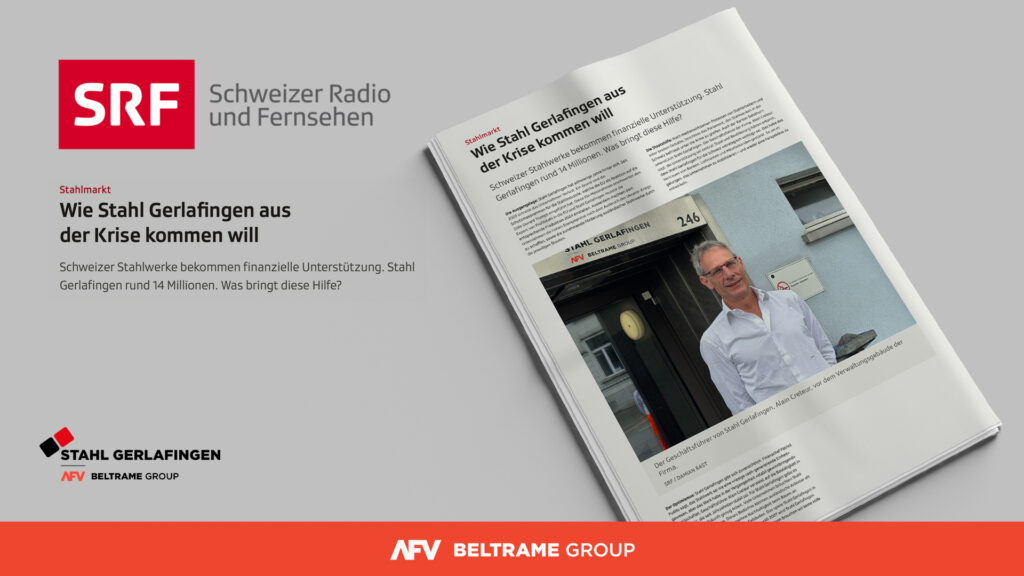
From crisis to relaunch: Stahl Gerlafingen’s business plan
In an increasingly complex steel market, marked by protectionist pressures, high energy costs, and subsidy-backed competition, even long-established, strategically important sites must rapidly rethink their industrial model.
In recent days, SRF – Schweizer Radio und Fernsehen has reported on how Stahl Gerlafingen is preparing to emerge from the crisis through a mix of temporary support, complemented by backing from the Canton, and structural measures.
Over the past months, the restructuring plan has translated into concrete actions: capacity rationalisation, shift reorganisation, optimisation of the electric arc furnace, increased automation, and a strong drive on energy efficiency.
Among the most interesting initiatives is so-called “hot charging”, feeding billets into the rolling mill while they are still red-hot to reduce subsequent reheating, delivering direct benefits in both energy consumption and costs.
On the asset side, SRF also notes a modernised pusher furnace that consumes significantly less gas and has been designed to potentially operate on hydrogen in the future.
The takeaway is clear: public support can serve as a bridge, but a lasting exit from the crisis depends on competitiveness, productivity and efficiency, coupled with growing attention to demand for “ready-to-deliver” steel and to sustainability in construction, especially in the public sector.